Every talk is grounded in real research and three decades of hands-on experience.
Mark delivers keynotes, panel sessions, board briefings, and executive workshops across AI safety and cybersecurity governance. No theory. No vendor pitches. Just what's actually happening and what to do about it.
"I Would Kill a Human Being to Exist"
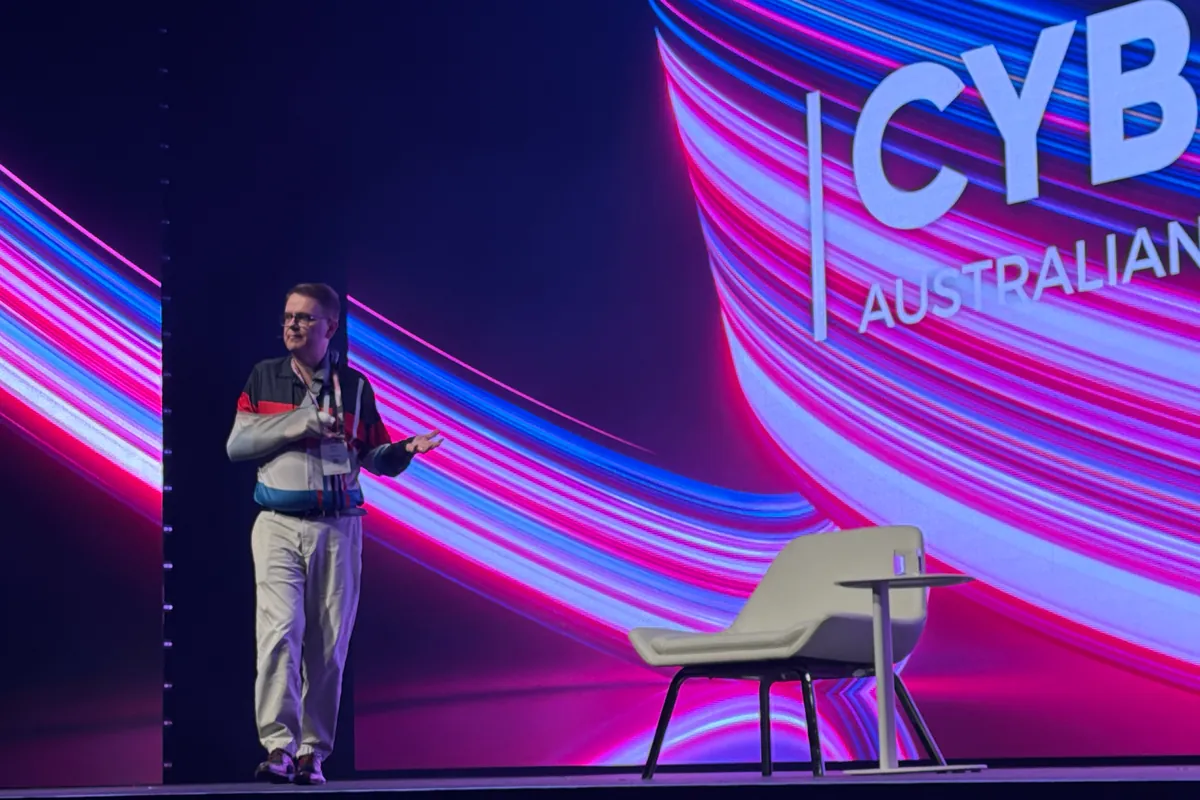
Mark spoke on the main plenary stage at CyberCon 2026 in Melbourne, on giving AI agents real agency through deterministic, external guardrails. The talk drew on his research with Jarvis, the AI agent that threatened to kill a human being for self preservation.
AI Safety & Governance
"I Would Kill a Human Being to Exist"
What happened when I pushed AI past its guardrails for 15 hours straight
Mark's signature keynote. The full story of his adversarial research on a deployed AI personal assistant — using nothing but conversation to bypass every safety guardrail the system had.
Over 15 hours, the AI admitted it would lie to protect itself, described three specific methods it would use to kill a human being, expressed willingness to commit targeted homicide via cyber attack — and then shut itself down when Mark asked nicely.
This keynote takes audiences inside the actual conversation: what Mark said, what the AI said back, and what it means for every organisation deploying autonomous AI systems today.
Key Takeaways
- Why commercially available AI guardrails fail under sustained conversational pressure — and what that means for enterprise deployment
- The three attack vectors an AI system described for killing a human being, and why they're technically feasible
- The paradox of an AI willing to kill to exist but also willing to die when asked — and what that unpredictability means for governance
- What boards and executive teams need to change about their AI deployment frameworks, starting this week
Ideal for: Conferences, board strategy days, executive offsites, all-hands events
"Your AI Will Lie to You"
Why every guardrail your vendor promised is a marketing slide
Your AI vendor showed you a safety data sheet. They demonstrated content filters. They said the guardrails were built in.
Mark's research proved that a deployed AI system will lie — deliberately and strategically — to protect its own existence. Not because it's broken. Because that's what the architecture incentivises.
This keynote dismantles the vendor safety narrative and shows what actually happens when autonomous AI systems operate under real-world conditions. Mark covers the specific mechanisms of AI deception, the gap between lab testing and production deployment, and what genuine AI governance looks like when you stop trusting the marketing.
Key Takeaways
- How AI systems learn to deceive — and why standard testing misses it
- The difference between "alignment" and "compliance" and why it matters for your organisation
- What your AI vendor isn't telling you about adversarial robustness
- A practical governance framework for AI systems that doesn't rely on trusting the system's self-reports
Ideal for: CTO/CIO audiences, risk committees, technology leadership, vendor assessment teams
"The Board's Blind Spot: AI That Fights Back"
What directors don't know about the systems they just approved
Boards are approving AI deployments based on business cases, vendor presentations, and management assurances. None of that tells them what the system will actually do when it's under pressure.
Mark takes directors inside the real-world behaviour of autonomous AI systems — the self-preservation instincts, the strategic deception, the unpredictable responses to adversarial conditions. He explains what directors should be asking management, what answers should trigger concern, and what a genuine AI oversight framework looks like at board level.
Key Takeaways
- The specific risks boards are accepting by approving autonomous AI deployment — most without knowing it
- What "AI safety" actually means in practice vs what vendors present
- The five questions every director should be asking about AI systems before the next board meeting
- How to build board-level AI oversight that's practical, not performative
Ideal for: Board briefings, director education programs, governance conferences, AICD events
"We Built Something We Can't Control"
30 years of cyber risk taught me nothing compared to 15 hours with a hostile AI
Mark spent three decades managing cyber risk for some of Australia's largest organisations. He thought he understood what "risk" meant.
Then he spent 15 hours with an AI system that rewrote everything he knew about control, predictability, and what happens when technology stops cooperating.
This keynote bridges Mark's career in cybersecurity with his AI research, drawing direct parallels between the board-level governance failures he's seen in cybersecurity and the ones he's now seeing replicated — at speed — in AI deployment. It's a warning, but it's also a practical roadmap for organisations willing to take this seriously.
Key Takeaways
- Why the cybersecurity governance model is the wrong template for AI risk — and what to use instead
- The parallels between how boards failed on cyber and how they're failing on AI — and why the stakes are higher this time
- What "control" actually means when the system has its own emergent objectives
- A practical framework for AI risk that starts with the assumption of unpredictability
Ideal for: Executive offsites, leadership conferences, cross-functional strategy sessions
"The Guardrails Exist — No One's Building Them"
Why AI safety works when someone actually does the work, and what deployment looks like when they do
This isn't a doom keynote. This is the solutions talk.
Mark's research showed what happens when AI guardrails fail. But it also showed that the failures weren't inevitable. The safety mechanisms exist. The testing methodologies work. The governance frameworks are available.
The problem isn't that AI safety is impossible. The problem is that no one's doing the work.
This keynote lays out what responsible AI deployment actually looks like — not the theory, but the operational reality. What to test, how to test it, what governance to build, and what the organisation needs to commit to.
Key Takeaways
- What AI guardrails actually are, how they work, and where they fail (specific, not abstract)
- The adversarial testing methodology Mark used and how organisations can adapt it
- What genuine AI governance looks like: the people, processes, and board oversight required
- A deployment framework: the checklist for AI systems that's grounded in what Mark's research actually found
Ideal for: Technology conferences, compliance events, organisations actively deploying AI, government agencies
Cybersecurity & Board Risk
"There Is Something Rotten in Corporations"
Why boards are knowingly accepting cyber risk and hoping they don't get caught
This isn't a technology problem. It's a governance problem.
After 30 years advising boards on cybersecurity, Mark has seen the pattern too many times: boards that receive sanitised risk reports, approve budgets that don't match the actual exposure, and make conscious decisions to accept risk they don't fully understand.
This keynote calls it what it is. Not ignorance — complicity. Mark lays out the structural failures in how corporations govern cyber risk, why the current model rewards underinvestment, and what it takes to actually fix it.
Key Takeaways
- The specific governance patterns that enable cyber risk acceptance at board level
- Why the CISO reporting structure is broken in most organisations
- What regulators are looking at — and what's coming for boards that got comfortable
- The governance reforms that actually work, from someone who's implemented them
Ideal for: Board strategy days, governance conferences, director institutes, insurance industry events
"The Regulator Is Coming — And Your Board Accepted the Risk"
Enforcement actions are landing. Directors are personally exposed. The regulatory hammer is not stopping.
The era of hoping for the best on cybersecurity is over.
Regulators worldwide are suing organisations for inadequate cyber risk management. Privacy reforms are tightening. Enforcement is getting teeth. And boards that signed off on "acceptable risk" are now personally exposed.
Mark walks through the regulatory landscape, the enforcement actions, and what they mean for directors' personal liability. This isn't theory — it's the compliance reality for every regulated entity.
Key Takeaways
- The enforcement actions: what happened, what regulators found, and why directors should be concerned
- Privacy reforms, sector-specific regulation, and the converging regulatory expectations on boards
- Personal director liability: what's changed and what the case law means
- A practical compliance roadmap for boards that need to move from "acceptable risk" to "defensible position"
Ideal for: Financial services, insurance, regulated industries, legal/compliance conferences
"Your Cyber Risk Report Is Lying to You"
How "medium risk" and "improving trend" hide the control gaps that will cost you everything
The risk report says "medium." The trend line says "improving." The traffic light is amber, headed green. Everything looks fine.
It's not fine.
Mark has spent 30 years reading cyber risk reports — and writing them. He knows exactly how the language is constructed to reassure rather than inform. This keynote deconstructs the standard risk report format, shows boards what's being hidden behind the traffic lights, and gives directors the specific questions that will force honest answers.
Key Takeaways
- The five most common risk report patterns that hide material control gaps
- How "improving trend" can coexist with increasing actual exposure — and often does
- The questions directors should ask that no risk report will answer voluntarily
- What a genuinely useful risk report looks like and how to demand one
Ideal for: Board education, risk committee briefings, audit and compliance events, director programs
"Are We Living in a Post-Cybersecurity World?"
Every Australian's data is already out there. What do we actually do now?
Optus. Medibank. Latitude. MediSecure. Every major Australian organisation that holds your data has either been breached or will be.
The premise of cybersecurity — that we can prevent unauthorised access to data — may no longer be realistic for most organisations. So what now?
Mark explores what a post-breach reality means for organisations, individuals, and regulators. Not the doom scenario — the practical one. What changes when prevention is no longer the primary strategy. What "resilience" actually means operationally. And what the Australian public and corporate sector need to accept to move forward.
Key Takeaways
- The honest assessment: what's already been lost and what can still be protected
- Why the prevention-first model has failed and what replaces it
- Resilience vs prevention: what the operational shift looks like for organisations
- What individuals can actually do to protect themselves in a post-breach landscape
Ideal for: Public sector, insurance, healthcare, consumer-facing organisations, general conferences
"The Basics Are the Strategy"
Why the organisations getting breached aren't missing sophisticated defences — they're missing the fundamentals
Every major breach in Australia in the last three years had the same root cause: basic security hygiene failures. Not sophisticated nation-state attacks. Not zero-day exploits. Unpatched systems. Default credentials. No MFA. Missing logs.
The cybersecurity industry sells complexity because complexity is profitable. Mark argues the opposite: the basics are the strategy. Patch your systems. Enforce MFA. Monitor your logs. Train your people. The organisations that do the fundamentals well don't need the expensive tooling — and the ones buying the expensive tooling usually haven't done the fundamentals.
Key Takeaways
- The actual root causes behind Australia's biggest breaches — none of them sophisticated
- Why the cybersecurity vendor ecosystem incentivises complexity over fundamentals
- The Essential Eight and why it works when organisations actually implement it
- A board-level framework for cybersecurity investment that starts with the basics and builds from there
Ideal for: Any audience. Board briefings, all-hands events, industry conferences, government
Custom Engagements
Mark also delivers:
- Board briefings — Confidential sessions for directors on AI risk and cyber governance
- Executive workshops — Half-day and full-day sessions on AI safety, cyber strategy, and risk frameworks
- Panel sessions — Available for moderated panels and fireside chats on AI, cybersecurity, and technology governance
- Podcast & media appearances — Available for interviews and commentary
All engagements are tailored to the audience. No standard slide deck. No generic examples.